Saturday, December 17th, 2011

Eight of Swords — Dragon Tarot

Artist: Peter Pracownik

Designer: Terry Donaldson


Interpretation: Little White Book missing


This is a deck my Mom picked up for me at a garage sale, hence the missing LWB. It is proof that I am willing to accept any deck into my collection, just to show the variety of tarot art out there. I am not a fan of dragons or fantasy, per se. In particular, I am not a fan of other peoples’ fantasy. I admit, it happens that my seven of cups has a couple of dragons drinking tea on it: that’s because the seven of cups is about fantasy.


The eight of swords is about being stuck between a rock and a hard place. It is about the feeling of being stuck without the complete actuality of being stuck. Sometimes there seem to be no option— or so many options it is impossible to chose. Some say it is best not to make any crucial decisions at this point. I say, there is one crucial decision that must be made at this point: how to get unstuck. Sometimes this means letting the mind go, accepting stuckness and going from there: “I am stuck, but what can I do?”  The dragon on this card looks slightly menacing. If I was to feel stuck and it was to say “BOO!” I would quickly feel unstuck— unless there was another, equally menacing dragon in the opposite direction.


Yesterday I wrote: “Stopping is getting stuck. The longer I stop for, the more thoroughly I will be stuck. I do not want to get stuck.” Today I am back in Vermont. Thus, aside from a few bad habits, (excessive chocolate, lack of exercise) and unfortunate situations (unemployment), I no longer feel stuck. Not here. My imagination is too great for that: I am more likely to have too many options than too few. This merely leaves me feeling inept at making a decision, not stuck.


I LIE! I am stuck: I have yet to illustrate the kings. Instead, I spend inordinate hours browsing the internet, looking for independently published small-run 78-card tarot decks (contact me if you have one) and sometimes (too often? not often enough? too often for an unemployed pregnant person but not often enough for my liking?) purchasing them. I need to get unstuck. Bring me to your leader— MANIFEST YOUR KING!

Friday, December 16th, 2011

Justice — Deviant Moon Tarot

Artist: Patrick Valenza

 
Interpretation: “A great judge balances two swords as he presides over the city. Although seemly fair, corruption often creeps from the seams of a just society. Upright: Balance. Strong character. Fairness. Reversed: Abused. Taking sides. Bias.”
 
I chose this deck because it is moody, like I am. I pulled justice upside-down. What is this— justice?
 
Justice is cold and unfeeling. Those who feel righteous when justice has been carried out are those who have not felt its sting. Those who feel wronged when justice is carried out are those who have been hit by the blade.
 
Justice is a search for the Truth. Justice is a decision as to what the Truth is. But what if there is no Truth? Certainly, some things seem more true than others, especially in the physical world. Many people insist that they know the Truth. But just as no two objects can be in the same place at the same time, is it really possible for two humans to have the same idea as to what is true and just? We all have different views and viewpoints. We have a myriad of multi-colored gods and eyes and each one speaks a different Truth.
 
It is impossible to get a group of diverse people to agree on what is fair and just. This is why we are supposed to have diverse juries: to decide what the majority of the people might be satisfied with in terms of justice. This is justice as distributed by humanity. Unfortunately, humanity is notoriously unjust, and it is quite difficult to get people to agree on a jury.
 
What is my justice today? What truth do I seek and what lies have I told myself? What decision do I need to make? Yesterday I spent most of the day sleeping: depressed. This seems to be happening periodically in my second trimester. It never lasts more than a day or two. I could blame it on pregnancy, seeing as how I have never felt like this before in my life. (Nor have my fingernails ever been so perfectly beautiful, but I am not complaining.) I need to make the decision to keep moving, to move forward, even when I cannot see where I am going and  I do not see the point. Stopping is getting stuck. The longer I stop for, the more thoroughly I will be stuck. I do not want to get stuck.
 

Thursday, December 15th, 2011

The Hermit — Kitty Kahane Tarot

Artist: Kitty Kahane

Booklet: Lilo Schwartz
 
Interpretation: “Follow your Star. // Be true to yourself and follow your own way. You alone know where your star is leading you, therefore do not let yourself be distracted by outside influences and well-meaning counsel…”
 
The hermit seems to have left the house in his bathrobe. Perhaps it is supposed to be an overcoat, but it looks fuzzy. So does his chin. May be he just got up out of bed, threw on a robe and went for a hike. Either way, no one is looking. He’s got a start to light his way and a little birdie on his shoulder.
 
The hermit is the old-man-self. Incorporating more of the past into one’s self allows us to understand what may come of the future. Knowing what may come of the future allows us to see where we are going, to allow time itself to become starlight that shows some roots and rocks in an otherwise shadowy path.
 
I am shy. I like the hermit. I have dreams that I keep hidden in fear of failure, or in fear that others will think them too strange. Perhaps sometimes my star’s a bit dim, because I should have learned by now that the few people I allow to my hermitage do not judge me nearly so harshly as I judge myself.
 
I spend hours alone, reading or doing yoga or wandering around outside and thinking, just looking. I like to see how one thing connects to another— becomes another— is fully and completely inseparate from another. Eventually, nothing that I want to be important seems important at all, and I feel helpless in the face of what is truly important. Whatever that is. At this point, it’s time I call a friend on the phone and talk pure silliness that certainly means nothing but is nonetheless quite crucial.
 
I am the hermit right now in Quebec. Martin is speaking French on the phone. His son refuses to accept that English might be a language of civilized people and suddenly insists he understands none of it: he doesn’t want it spoken in the house. Outside it is raining or snowing something awfully wet. Down the street is a bike path that leads in one direction or the other but veers little and never forks. There are people on the path sometimes. If they spoke to me, I would not understand them. In the sprawling local suburbs there is one box-shaped store after another selling things that we are foolish enough to think might make us happy. A star is a very large, very heavy thing to carry. I want to go home so I can put the star on its shelf for a while and sleep in my own bed.
 

Wednesday, December 14th, 2011

Page of Pentacles — The Lover’s Tarot

Jane Lyle[NOTE: Not that I’m doing deck reviews here, but I dislike it when some “artist” does a lot of (often poor) cutting and pasting from classical images and then doesn’t tell us where the images are sourced. All ‘ye artists out there: see Karen Mahoney & Alex Ukolov’s excellent book for the Tarot of Prague for an example of beautifully sourced artwork.]


Artist: Oliver Burston
Book: Jane Lyle


Interpretation: upright: It is a joyful, happy card wherever it falls. Listen to your voice. Pay attention to your dreams. inverted: Something is not what it seems. Take time to assess the reality of a situation.


Generally, I look at every card upright. As Brian sang, while hanging on the cross, Always look at the bright side of life— (ba-bum, ba-bum ba-bum ba-bum)  When I flipped the card over, my first thought was, “It’s upside down.”  Either way, it does makes sense to look at both sides at once. Thus: listen to your voice and take time to assess the reality of a situation.


Jane Lyle’s book that comes with the deck is, as implied, skewed toward affairs of the heart. Her emphasis is on self-reflection and introspection, not divination. She asks us to ponder —does this card represent an individual? —yourself? —a situation or a relationship phase? —and says: “When describing an aspect of personality, it heralds an intuitive, creative phase, and has close links with the first stirrings of romantic love and desire.”


If I am a romantic at heart, which I say I am when defining my heart, than all my love is romantic. As for desire— who is free from desire?


In this intuitive, creative phase heralded by pregnancy (intuitive because I haven’t a clue what I am doing; creative because I’ll be making everything up as I go along) there are many things that will need to change. The page of coins tells me to pay attention to what I need to do to manifest my dreams in the material world.


One simple change: Martin suggested we move to Quebec. (The more complex changes that come after having a child are currently incomprehensible to me, and thus outside the scope of my dreams.) After a long period of refusal, (too far from my family, I don’t know the language, I’m sick of making new friends, too isolating, etc.) I am now in love (or perhaps it is lust) with the idea of moving: I have had a change of heart. This material change (relocation) will help me manifest my desire to learn French.


I am especially in love with the idea of Quebec City. What ecstasy to fall in love with an old city— with its arches and staircases— stone walls and churches— steeples— statues— parks and windows— doorways— curves and corners— O! deliciously sensual. I dream of wandering alone. Today I am off to initiate my love affair with Quebec City…

Tuesday, December 13th, 2011

Nine of Coins — Tarots Oreste Zevola

Artist: Oreste Zevola


The little white book that comes with the deck is all written in French and says nothing of the minor arcana.


I had Martin draw this card, so it is for him, not me. He speaks French, so he and the deck should get along, one would think. Except, his initial reaction upon looking at the card was, “Ooh, scary.” It’s not supposed to be scary. It’s just how the card looks, with what seems to be some horned zombie on the bottom with a lizard across its face and two dismembered arms and an upside-down, somewhat anatomically-correct heart. Or at least, this is what I see. No wonder this is not a terribly popular deck.


The artist’s interests lie in design and primitive art with a slightly surrealist bent. This is the angle from which he approached his deck. He has little interest in the deck as an occult tool of divination. This should not stop us from using his cards as divination tools: the first decks were meant only for gaming, and yet it is from these decks that the whole system of esoteric divination was devised. And although he seems slightly interested in the cards as a game, his deck design precludes using it as such: the cards are so awkwardly long they are impossible to shuffle.


So I return to divination and the occult and whatnot. The nine of coins is about enjoying the good life and harvesting the fruit of one’s labor. This is generally a pleasant card, I think, but that the small image on the bottom seems to show the harvest as one’s own arms and heart. Maybe this is the harvest, as everything we are successful at producing is product of our arms and heart. And sometimes, maybe, the harvest seems painful and heartbreaking, because afterward we have to let it go. But when the fruits of our labor are properly harvested, we should retain our arms and heart that we might go on to use them another season.


As Martin said, “Ooh, scary.”
As I said, no wonder this is not a terribly popular deck.

Monday, December 12th, 2011

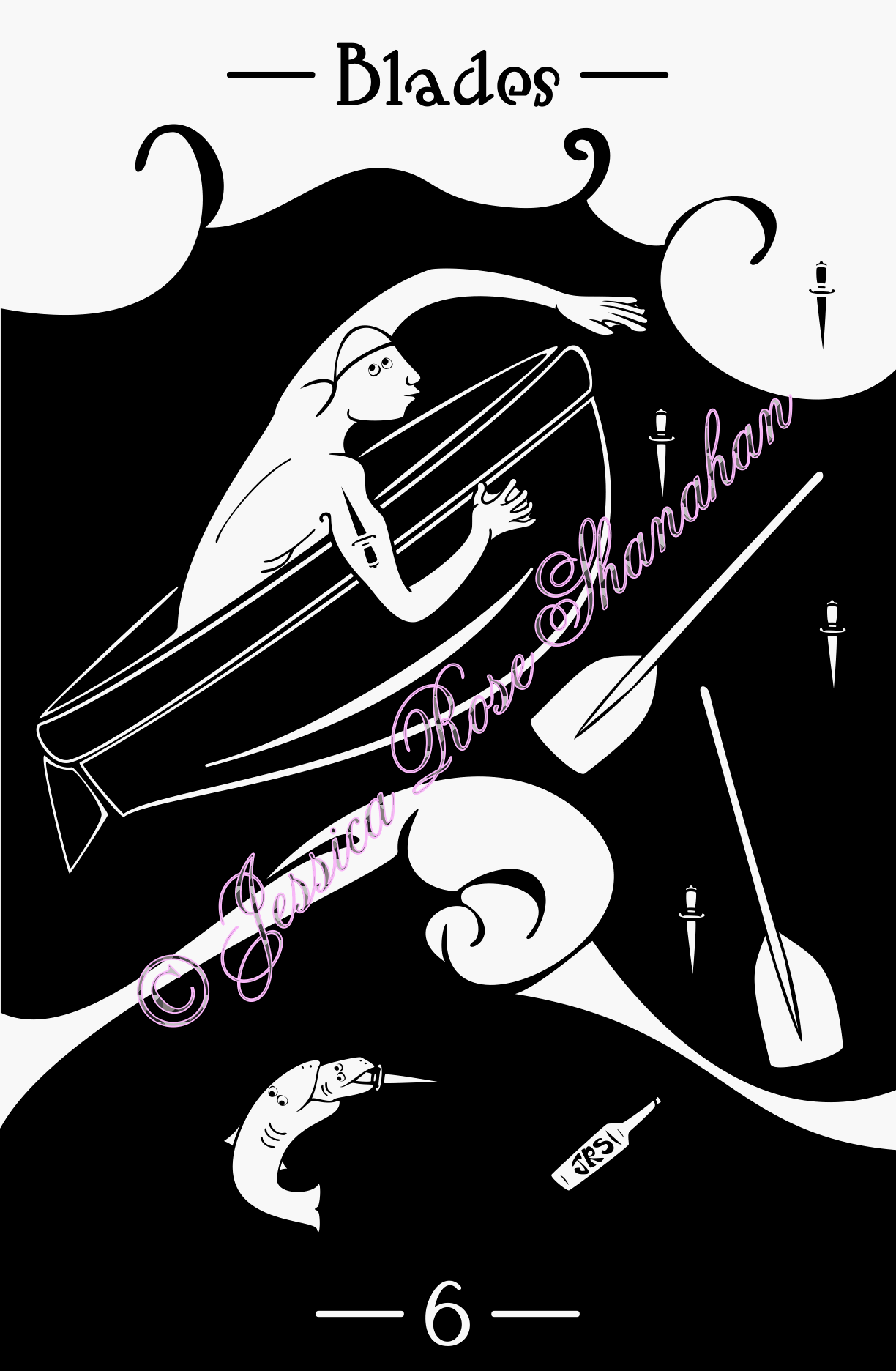
Page of Cups — Tarot of the Absurd

Jessica Rose ShanahanArtist: Jessica Rose Shanahan


Interpretation: A dreamy youth or youthful dreaming. The surfacing and realization of emotions. Artful expression. Inspiration from the realm of the unconscious and the spirit. The beginning of a creative project or venture.


I think my dreams have always flown like books in the form of butterflies— or butterflies in the form of books. I am ever the youthful dreamer. The main purpose of this blog is to extract a storm of words from my brain in order that I might have enough material to write a book within a year and a half. Then I just have to edit everything and publish it somehow. So simple to say! So easy to dream! So challenging to do—


When I began this deck over a decade ago, I was using the tarot pack as form and framework for an illustration project for myself.  I saw the deck as a mythic tradition, similar to faerie tale or fable. For each card, I would use a certain number of traditional symbols to illustrate a given meaning. It was a dream, and the more I learned of the reality of the tarot deck— or the lack thereof— the more difficult my task became.


Even the simplest of things are inconsistent: the four suits are called by different names and people interpret the cards in ways that make sense to them. The mythology of tarot makes divination integral with multiple forms of divination and magic: the zodiac, kabbalah, the elements, alchemy, the divine name, etc. It has been said to come from the Gypsies via Egypt. It has been said to be a lot of things. Beautifully so, with just a little tweaking here and there, it can align with any system one chooses to align it with. Verifiable history, on the other hand, is another matter. Truth is often the destroyer of dreams.


I am currently reading A Wicked Pack of Cards by R. Decker, T. Depaulis & M. Dummett. It is an excellent account of the history of tarot as a playing pack and how it came to be transformed into a popular method of divination. Although some people prefer to know only some mythology and are satisfied to call it truth, I prefer to see how mythology interweaves with history and realize that neither is complete without the other. I believe that learning names and dates of history does not destroy the tarot as a tool of divination— though some may have no interest in such stuff— either one or the other.


I am the dreamer of my own mythology. I do not see differing mythologies as systems that must necessarily be in conflict. Hindu Mythology, Greek Mythology, Judeo-Christian Mythology, Zodiac Mythology, Egyptian Mythology and Evolutionary Mythology can all live in peace with one another, if we choose to be peaceful people. There is no need to wage wars. We just need to agree that every truth is also a mythology, and each mythology a truth. What a beautiful dream that would be!


Sunday, December 11th, 2011

Five of Wands — Bruegel Tarot

Artist: Guido Zibordi Marchesi


Interpretation: “Ambition. Those who rise too high often fall (It’s easier for those who rise too much to fall).”


I learned fives as cards of conflict. While working on my own deck, I have illustrated the cards in mostly random order, depending on which card I am able to embody next. The first card I illustrated was the star, back near the end of the last millennium when I thought I was doing a majors only deck and knew nothing much about tarot. The fives are some of the last cards I have illustrated. The fact that I had such issues illustrating fives shows I have problems with conflict.


I am my own fiercest competitor, my harshest judge, the first one to notice when I have climbed too high and fallen. The battle of the five of wands weaves itself in and out my mind and my environs. It is a clownish battle. The one who cares most about the result is my self. None of this is fun. My conflict is not fun. I wanted to illustrate the fun cards first.


The cards in this deck are strewn with symbols that are truly occult, from the Latin word occultus: clandestine, hidden, secret. They are occult because the artist chose not to publish a book pointing out the meaning of all the hidden symbols in his work. Curses upon him! This leaves it up to us, the readers, to divine what his symbols mean.


Ultimately, symbols in a work of art take on the meaning that the we, the viewers, give them. If we are unable to relate to anything in an image (or a story or a poem or a life), we pass it by. If some one tells us, “Look at this— look at this—” we are more likely to stop and look and relate and say, “I see!”


Dare I ask— Am I the woman in the green dress: about to step on a rake and smack my head? Have I fallen off a mountain? Am I climbing a tree with a cudgel too large in pursuit of an animal that has already fled?


In the end, we are all peasants, common people wielding the tools of our trade in argument. If any of our weapons should break, we will be unable to work. What are we arguing about? Is anyone listening to anyone else? Are we even listening to our selves?

Saturday, December 10th, 2011

Five of Swords — Tarot of a Moon Garden

Artist: Karen Marie Sweikhardt


Interpretation: “Divinatory Meanings: Conquest. Defeat. Destruction of others. Degradation. Adversary may arise. Revocation. Infamy. Dishonor. Reverse meanings: Uncertain outlook. Chance of loss or defeat. Weakness. Possible misfortune befalling a friend.”


I’ve got a cold. Invading armies of germs see my immune system is down and break through the weakened fortress, multiplying by the billions. I defend with copious amounts of snot. My throat is raw. My head aches. Perhaps I will try to burn them out with fever.


In the Tarot of a Moon Garden, swords are represented by the dragonfly’s abdomen. When mating, male dragonflies embrace females with spiny claspers in a vise-like grip that often leaves the female with gouged eyes, a punctured exoskeleton, and a split head. A male dragonfly uses his spoon-like and sometimes spiky penis not just to transfer sperm to the female, but also to scrape out rival sperm from previous matings. Sexual conquest at its finest.


Every conquest involves a defeat. Sometimes it is difficult to ascertain whether I am the one with a hollow victory or the defeated person or the one who gave up preemptively. This card may mean any of those, depending on the situation and how one chooses to view it.


My situation: I am in Quebec— my boyfriend’s other home— where everyone speaks French and I can say “Je ne comprends pas,” but I don’t need to, because it’s obvious I don’t understand. His son is 10 and, aside from having the normal why-does-Papa-have-to-bring-his-girlfriend response to my visits, he also gets to be especially annoyed that I am a complete idiot in French.


In any good relationship, there is no grand conquest or defeat, just a thousand little things we have to put up with in each other. If any of us choose to battle, there will be victory and there will be defeat and there will be degradation and there will be adversary. We choose when to battle and when to avoid conflict. Perhaps the five of swords can be a reminder to remain peaceful.

Friday, December 9th, 2011

Five of Cups — Napo Tarot

Created by Betty Lopez; Designed by Napo


Interpretation: “Frustration prevents one from seeing the cups brimming with happiness. The three amphoras pour out illusions and bring dejection and melancholy. Disillusionment. Disappointment.”


An amphora is a wheel-thrown terracotta container used to store liquid. If these amphoras are pouring out illusions, he must have thought his cargo was more precious than he found it to be upon spilling. Or perhaps it was very precious liquid indeed, and he was under the impression he would be able to manage it without spilling.


I just drew a five of cups two days ago. Am I disappointed and frustrated, as this card suggests? (possibly) Am I lying by not letting on how disappointed and frustrated I actually am? (possibly)


I thought I was going to be able to work through most of this pregnancy, but about a month and a half ago I got fired for pregnancy-induced-moodiness. Plus, my boss was an unappreciative jerk. I thought I was going to be able to be more active than I am, but five days ago I woke up with a pain in my neck so acute I went to see a chiropractor for the first time in my life. So, yeah, I’m frustrated and disappointed, but I don’t think my illusions were that great. Not most of them. The illusion that the chiropractor might actually help was briefly large and wonderful. But nothing truly terrible and irredeemable has happened to me. Despite some long hours spent dwelling in the pits of despair, it’s actually been quite good. I think it is important to spend a moment (but not too many moments) looking at what is lost before picking up and moving on. Things that are truly lost cannot be had again.


The act of loosing something is an act of presence. Once something is lost, the thing lost is in the past and the present has moved to another moment. It is important to keep up with the present— not in terms of the cut of our jeans or the operating system on our computers— but with our minds. If our minds are constantly elsewhere, then nothing will ever happen in the present. Nothing as good as what did happen or what could happen can happen now if the mind is not present.


Look at what spilled. Turn around. Look at what remains. Take this. Move on.


Thursday, December 8th, 2011

The Star — Tarot Lukumi

Artist: Luigi Scapini
Author: Emanuele Coltro Guidi
 
Interpretation: “The stars are so far that they don’t listen to anyone. The path (avatar) of Yemaya, Yoruban Goddess of the sea, called Asesu is a deaf Entity. Yemaya Asesu goes on with her business and doesn’t listen to much. The patiki tell us that before listening to questions she counts all the feathers of a duck who was sacrificed as ebbo to her.”
 
Part of the purpose of the Tarot Lukumi deck is to build a bridge between the world of Cuban Santera (Relga de Ocha or Relga Lukumi) and the occult tarot to demonstrate universality of the rules of Magic. I am especially fond of this purpose.
 
Throughout the history of the occult tarot, different readers have used their preferred method of magic to divine meaning from the cards: Astrology, Kabbalah, Masonic Hermetism, Jungian psychology, and so on. In order to find meaning in a foreign system, one must find the correspondences with an understood system. This is the basis of syncretism. It is also the basis of learning to love one’s neighbor as one’s self.
 
Santeria is an anamistic religion coming from the syncretism of the religion of the west-African Yoruban tribes people and Catholicism. Following their abduction to the Indies for the purpose of slavery, Spanish law mandated that these people be baptized Roman Catholic. But Catholicism was not a big hit among the slaves. [If someone abducted me from my homeland; placed me on a ship in a manner similar to which I do not approve of cattle being treated; left me there for weeks with minimal life support on a nauseating ocean voyage; separated me from my family & sold my children & subjected me to a life of forced labor I, too, would have trouble accepting their notions of god.] In attempt to appease their tormentors, many slaves pretended they were Catholic. Thus began the syncretism of Yoruba and Catholicism into Santeria.
 
The Star, in this image, is pictured as a mermaid sitting on a sandbar pouring water from two conch shells into the sea. Behind her is the sacrificial duck whose feathers she counts before listening to questions. In the sky are seven stars.
 
I learned the star as a card of hope, and when I think of hope, I think of Pandora. In Greek mythology, Prometheus, champion of mankind and traitor to the gods, stole fire from heaven. Zeus punished Prometheus by binding him to a rock. A great eagle ate his liver every day; the liver grew back and was eaten again the next.
 
The gods, still bitter that Prometheus had given the gift of fire to man, then took vengeance on humankind by means of Pandora, the first mortal woman. Pandora was endowed with every gift known to women: beauty, grace and desire from Aphrodite; cunning and boldness from Hermes; gardening msp free vip codes from Demeter; manual dexterity and spinning from Athena; sweet singing and lyre playing from Apollo; and a pearl necklace from the god of the sea who promised she would never drown.
 
The gods then placed every plague and sorrow into one jar and presented the jar to Pandora with the instructions do not open under any circumstance. Pandora was then presented as a gift to Prometheus’ brother.
 
So of course Pandora, endowed with an ample amount of curiosity, opened the jar. Out poured Death, Sickness, Insanity, Pestilence, Addiction, Greed, Theft, Lies, Jealousy and Famine and on and on until all the evils were loosed upon the earth. Then out the bottom, just before she managed to slam the lid, flew Hope. It is Hope that sustains humanity.
 
Anyone who calls on a deaf goddess who counts all the feathers of a duck before listening to a question really has run out of places to turn for help. It is when we feel most alone and lost that we need to call on hope the most.
 
Shining, shining in the basket’s bottom,
a jewel of hope lies beneath
the monsters of destruction.