Tuesday, December 27th, 2011

Six of Blades — Tarot of the Absurd

Jessica Rose ShanahanArtist: Jessica Rose Shanahan


Interpretation: Leaving a storm for calm waters. Change of thought or place. A journey through the watery mind. Attempt at harmony. Finding understanding. Rite of passage.


A man in a boat on stormy seas has lost his oars. He surfs a great wave as daggers fall from heaven. But it is not a hopeless situation. His eyes are the eyes of a fish, eyes that see through confused waters. His hands are webbed, like fins. On his head he has a swimming cap, and on his arm, the tattoo of a blade. These blades are nothing new. He is prepared for this and knows more than he thinks he knows. He will not sink. And when he swims, he’ll find a message in a bottle.


The only thing that could hinder him is baggage. One cannot swim with too much baggage. A stubborn, clinging mind will never change. To swim, he needs to let his boat go, to let his baggage go, to keep his mind clear, to keep his aim focused. To read the message in the bottle he needs to use both hands and leave all else behind. It is easier to find harmony in simplicity than in chaos.


The purpose of this blog is to gain a better understanding of the cards
that I might better be able to explain the images in my deck
and someday write a little book.
Monday, December 26th, 2011

Knight of Wands — Pearls of Wisdom

Roxi Sim[My brother Dan picked this card. He pulled it upside-down.]


Artist: Roxi Sim
Booklet: Caeli Fullbrite


Interpretation: “The journey is begun. The knight follows his inner promptings and advances into the unknown. He acts as a messenger bringing very good tidings. He loves adventure and finds it difficult to stay in one place very long.”


If the knight of wands loves adventure, than he is certainly stymied being upside-down. He is stuck. Life feels meaningless. He is frustrated about factors over which he has no control. How does he turn himself right-side up?


There are things he can change; there are things he can control. Maybe they are just different things than he wants to change, or different things than he is focused on. Maybe the only things the knight of wands can change are things he doesn’t want to change. Who knows?


People seeking help to try to change their lives are often taught this prayer: “God, grant me the serenity to accept the things I cannot change, courage to change the things I can, and wisdom to know the difference.”


It takes more work to flip a life around than it does to simply flip a card around. Sometimes it seems impossible; a dream. Use your imagination and your skill at creation. Draw doorways where you see walls. Make this dream a lucid dream.


Sunday, December 25th, 2011

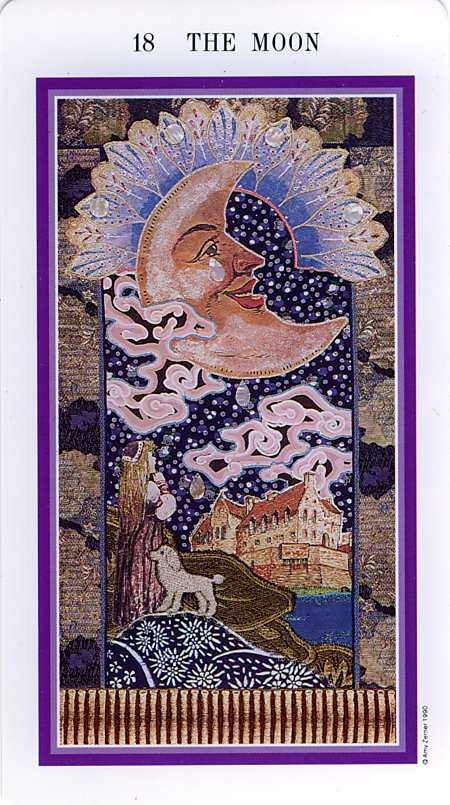
18. The Moon — Sakki-Sakki Tarot

Artist: Monicka Clio Sakki
Author: Monicka Clio Sakki & Carol Anne Buckley
 
Interpretation: dreams, unconscious, inner-self, confusion, deception, mystery
 
“The landscape that the Moon’s light reveals is a complex one. Along with its power to fascinate, the Moon arouses disturbing feelings, even madness…. The Moon provokes a psychic awakening, and lights our escape into the domain of our imagination.”
 
I am driving to Syracuse today. It usually takes me about six hours because I drive 55-60 mph, take the occasional accidental detour, have to pee a few times, and maybe nap. My goal is to leave before noon. Despite my love of the moon, I hope not to drive by its light, lest I succumb to shadows one after another. Confusion leads to deception, letting me be overcome by the mystery of what I see as I drift into the land of the unconscious dreamer where there is nothing left but inner-self.
 
I will not deceive myself: these blog entries often take quite long to write. I have yet to pack. The truth is, I must leave by the light of day if I am to sleep in my parents’ house tonight. My inner-self is not licensed to drive a car without the full awareness of my outer-self. I would like to arrive at my destination intact.

Saturday, December 24th, 2011

11. Strength — The Shakespeare Oracle

[One well versed in Shakespeare could use this deck to learn tarot and never need to look up a meaning in the book.]

Artist: Cynthia von Buhler
Author: A. Bronwyn Llewellyn


Interpretation: “This card suggests fortitude, confidence, and command. This isn’t the raw courage and endurance needed to leap into battle, but the inner strength to do what has to be done, no matter how difficult or long it takes.” Etc.


I keep forgetting to ask a question. I have no idea what this card answers other than the eternal question “Who am I?” This is not a bad thing. Ramana Maharshi tells us:


“Who am I” is not a mantra. It means that you must find out where in you arises the “I”-thought which is the source of all other thoughts. [AND] Self-enquiry is certainly not and empty formula and it is more than the repetition of any mantra. If the enquiry “Who am I” were a mere mental Questioning, it would not be of much value. The very purpose of self-enquiry is to focus the entire mind at its source. It is not, therefore, a case of one “I” searching for another “I.” Much less is self-enquiry an empty formula, for it involves an intense activity of the entire mind to keep it steadily poised in pure Self-awareness.


Unfortunately, the simplicity of meditation is more complex than the complexity of reading tarot:


To enquire “Who am I?” really means trying to find out the source of the ego or the “I”-thought. You are not to think of other thoughts, such as “I am not this body.” Seeking the source of “I” serves as a means of getting rid of all other thoughts. We should not give scope to other thoughts… but must keep the attention fixed on finding out the source of the “I”-thought by asking, as each thought arises, to whom the thought arises. If the answer is “I get the thought,” continue the enquiry by asking “Who is this ‘I’ and what is its source?”


Each tarot card answers “Who am I” in a different way. Each card shows something different in myself. At any moment, I embody every card. When I pull a card with no question in mind but “Who am I?” the answer is always, “You are this.” Then I find the part of me that the card speaks of and how I currently embody that aspect.


I pulled the Strength card and thus ask, “How am I Strength?” I see that I embody many aspects of strength in its positive attitude. Although often I am uncertain of what I am doing, confidence in my self and my world-view gives me strength. I admit I pulled the card upside-down, and seek meaning there. It tells me to watch for self-doubt and lack of faith. These are things that weaken me.


you are strong: be strong be strong
Friday, December 23rd, 2011

Nine of Wands — Tarot of the Immagination

Artist: Frenec Pinter


I have neither Little White Book nor box for this deck. As with all cards, different people interpret the nine of wands in different ways. This reading is my feeble attempt at art interpretation, which is what I am left with when no one tells me what to think.


The man in the foreground is fishing at the edge of a canal. It looks like he is wearing fatigues and a Russian army hat. He is sitting on a poster of Lenin. Is this image during the war years, when Lenin, standing for maximum working-class democracy, lead the workers of the Tsarist Russian Empire to revolution? Or is it afterward, when the Stalinists, calling themselves Leninists, cut away at everything Lenin had worked for and adopted anti-working-class policies? I never paid attention in history class. There were too many wars and dates and dead white men.


Inner strength, stamina, and the will to go on despite impossible odds are at the center of the Nine of Wands. I would like to say, the man is a revolutionary. He sits on the ideals of Lenin, protecting them, making them his own. But the revolution is going on forever. So many people he knows have died. Will the war never end? It is so dark! If only he can follow the light of his inner strength, it will lead to glory.


The twist: there is glory for the Bolshevik Party, but all too soon their ideals are crushed and twisted. The revolution is stolen from the hands of the revolutionaries. The struggle of the working class has never ended. Only in heaven is there a chance for the light of inner strength to close its eyes in sleep, just for a moment.


This card shows that if we search deep inside ourselves, we will find the strength to endure.

Thursday, December 22nd, 2011

Three of Pentacles — New Age Tarot

[NOTE: Notes within brackets within quotes are my notes, not quotes.]

Artist: Walter Wegmüller


Interpretation: “Symbolic of a profitable training course or experiences. [Knowledge as wealth.]


“The Three of Pentacles also represent the three time references where money is concerned: savings (past), use (present), and investment (future). [These numbers may be negative or positive.]


“In yet another sense, it also stands for coined money [most often fiat money, without intrinsic value yet endorsed by the government], toy money [unendorsed, legal money: virtual money; Monopoly money; money from another country] and counterfeit money [unendorsed, illegal money: stuff that seems real but isn’t; something too good to be true].”

 
The oldest decks depicting little round discs with symbols on them used the term “coin” to denote the suit. “Pentacle” is a later term, associated with tarot after the deck took on occult meaning. Technically, a pentacle is an amulet used in magical evocation on which the symbol or spirit or energy being evoked is depicted. In tarot decks, a pentacle it is usually denoted as a coin with a pentagram inside.

I like how the author/ illustrator of the deck calls the suit “pentacles” without illustrating the usual pentagram. Instead, he fills his coins (and his cards) with magical images from around the globe. However, his use of the term “pentacle” conflicts with how strongly he relates all his pentacles to actual money instead of to more general, practical, earthy and material matters. Money is a societal convention. It is not the most important form of wealth at all. Our society is too focused on money money money.


I leave money out of the suit of pentacles— tho I do call it coins. The three of coins reminds us that one form of wealth is the skill necessary to accomplish a goal. Good planning and organization are necessary to succeed and to improve the quality of life. Learn well, work hard and stay on top of things. With a little luck thrown in the mix, you will succeed.


Now I need to tell that to myself and get a move on finishing this deck.

Wednesday, December 21st, 2011

Three of Swords — La Corte dei Tarocchi


Artist: Anna Maria D’Onofrio


[I didn’t really want to draw this card. I wanted the one above it, but this one fell out of the deck so I felt obliged to take it.]


The three of swords is
that normal-sort of heartbreak—
when you live and things hurt
because you are willing to feel them.


If you aren’t willing to feel
nothing hurts
but that is not living.


It is very difficult to stay not-living
while walking on this earth.
Not even people-hating people are non-living.
People-hating people hurt and hate
and maybe live in heartache more
than you or I with broken hearts.


Zombie-people are the sort
who never draw the three of swords.
I do not know what sort of cards they draw—
they have no future and no past because
they are not present.


Maybe, soul-less, they draw the devil every time
and devils only devils.
Maybe I am wrong— perhaps
they draw threes of swords one after another—
threes and threes of swords that scream—
feel something! feel something!— but—
they cannot hear because
they are not present. Silence.


Zombie is a state of deep, near-death addiction
where times of lucidity are so few or never that
no light comes in and then there is no point
and then there is no living— real death—
beyond which there cannot be feeling like we feel—
feeling that makes us alive.
Feeling makes us alive. Be thankful and
be thankful for the three of swords.
Tuesday, December 20th, 2011

13. The Journey — The Wildwood Tarot

Artist: Will Worthington
Authors: Mark Ryan & John Matthews
 
This card corresponds to the Death card in the Marseille Tarot.
 
“The first step is to ask the initial question,” write the authors. “This is the most overlooked part of any divinatory system… the act of asking focuses the mind. The desired answer or even the real question itself may be buried so deep in our own subconscious that we need the help of Tarot to reflect our own unknowable truth.”
 
The truth is, I have not been asking a question other than which card will it be? what will it show me? When I pull cards for this blog, I am not searching for insight. I merely seek the ability to understand the cards more thoroughly. But if I want to get a better answer, I have to ask a better question.
 
This deck has caught me unawares. The book is extremely well written. I do not just want to jump to the card and see what it means. I want to read the book, understand where the authors are coming from, and move from there. I am the sort who reads instruction books cover-to-cover. I hope my book will be so enticing to others.
 
From the book—
It is time to face the inevitable, to let the bones be laid bare and acknowledge the deepest aspects of your fears and desires. Do not fear change, because this is also a time of purification and realignment. This change may seem extreme and destructive, but old crops must be cleared for new growth to thrive and static or sterile modes and concepts must perish. A celebration of the past or an acknowledgement of the passing of  one part of life may be required. Let the threads of the old slip from your fingers with joyful remembrance and enter this time of withdrawal and renewal with patience and calm.
 
I had trouble calling my death card “finished” for a long time. I was trying to illustrate death as something that begins in childhood and grows with life. Death is there all along; it is nothing new. I drew people of three ages dancing with snakes that grew with them, both the snakes and the people enjoying life. Death enjoys life. Over and over, death enjoys life. Still, something was missing. That something was death itself, a fourth stage of life, like the four seasons of the year. When I added the skull, death became complete. I was not afraid that death was part of life; I was afraid that death was part of death.
 
Here is a celebration. Before the birth of my child, celebrate the death of my self: my selfish-self: my self who wanted to be only-self for so many years and had “too much to” do to be devoted to another self. I think it would be a good thing: to say good-bye thoroughly to what I no longer need, that I might greet with purity what I desire.
 
I am excited for this death and birth of life.

Monday, December 19th, 2011

Five of Cups — Tarot of the Absurd

Jessica Rose Shanahan
[This is my third five of cups in all my 14 days of one-card readings. What am I, depressed?]
Artist: Jessica Rose Shanahan


Interpretation: Inability to see that, when the glass is half-empty, it is, indeed, half-full.


The man in the picture is glum. He is angry and disillusioned. He is sad for his loss and the imperfection of his life. He is sulking because all he can see is what is lost— the four spilled cups in front of him. If he would only look around— take a peek over his shoulder— he would see that all is not lost. One shining cup hovers behind him, floating in the air like an apparition! Do not give up hope! Look for the positive! To do so requires a change in attitude. To see the bright side of a seemingly dismal situation takes a change in point-of-view. Stand up, walk over, turn around. The present situation is unstable and needs to change. Regret is useless. Look and see— what is possible?

Sunday, December 18th, 2011

Female Knight of Staves — Cary-Yale Visconti Deck

Artist: unknown
 
Interpretation: upright: Confidence. Letters. Faithfulness. A friend of many years comes to visit. inverted: Lack of commitment. Gossip. Bad news. Disillusionment with an old friend.
 
I wonder who thought up this interpretation—
 
The main founding father of tarot occultism, Antoine Court de Géblin, was a “Protestant pastor, Freemason and savant (p 52).”* Court de Géblin was one of the founding fathers of the Plilaléthes, an esoteric cult who combined, it seems, most any en-vogue and occultist literature into their doctrine. He wrote innumerable unscientific articles and essays on the history of  civilization all the while demonstrating a disdain for serious evidence and rational thought.
 
In the early 1770s, Court de Géblin was introduced to the game of Tarots by a woman who was visiting Paris from “Germany or Switzerland.” Within the course of fifteen minutes, he scanned the entire pack. He immediately declared it thoroughly Egyptian and announced that its secret knowledge had survived so long because the deck was disguised as an instrument of play instead of the antique book of wisdom it truly was. “He did not pretend to have derived his knowledge from any ancient tradition, orally transmitted… for long ages no one had suspected the truth until he himself had with his genius perceived it and uncovered it (p 58).”
 
Court de Géblin had grown up in Switzerland and thus had seen the cards as a child, but not since. The game of Tarots was, at the time, still popular in Switzerland and generally forgotten in France. This foreignness was an essential element in Court de Géblin’s ability to spread his grandiose theories of the origin and significance of the tarot pack.
 
The deck that Court de Géblin saw in the woman’s possession was one of 78 cards. It is important to note, as demonstrated with this 86-card Cary-Yale Visconti Deck, that not all decks used in the game of trumps had 78 cards. Decks and their suits and trumps were regionally consistent, but not internationally consistent. Whereas the number of cards is significant in contemporary “traditional” occult methods of divination, all that is important for game playing is that the players are familiar with the deck and agree on the rules.
 
The first professional cartomancer, Jean-Baptiste Alliette, or Etteilla as he was known, also used a 78-card pack. He “corrected” many of the trumps to show images we are more familiar with today. His numbering of trumps differed from the order used in play in the tarot of Marseille and contemporary occult tarot, and the meaning of the numeral cards has evolved significantly since his time. However, the number of cards in the occult tarot deck has remained consistent from Court de Géblin’s “discovery” in the 1770s.
 
That is, until the mid 1990s with the addition of the Happy Squirrel Card in the Simpson’s episode #19, Lisa’s Wedding.
 
So, when Stuart Kaplan took to publishing facsimiles of antique tarot decks, who took on the task of assigning esoteric meaning to the additional eight cards in the Cary-Yale Visconti Deck? My guess is Stuart R. Kaplan himself, who has earned great recognition for his contributions to the occult tarot since the late sixties.
 
*R. Decker, T. Depaulis & M. Dummett A Wicked Pack of Cards, St. Martin’s Press, 1996. History of the tarot deck & all quotes from this source.