Wednesday, July 4th, 2012

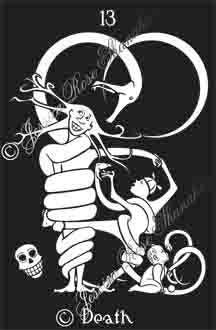
Death — Tarot of the Absurd

This was one of the earlier cards I illustrated.


I was trying to show how death is a part of life: how our death is born the moment we are born and it grows with us. We look at death each day and it grows so familiar, we often forget its power and take needless risks. But risk is exciting! Touching Death is thrilling!


The curve of the large snake’s head forms an infinite loop with the moon, signifying the endless cycling dance of Death and Birth. I liked it well enough, but it was not until I realized that Death is also a part of Death that I added the skull and the card felt complete.

  DEATH
Withdraw this corpse—
this footprint— this echo—
this last dissolving trace
of some self-ceased situation.
Back implies front.
Poles of the magnet
appear at different times.
Each birth necessitates
a new life’s end.
A pendulum swings—
at the apex of each turn
perpetual movement
hesitates to a stop.
This turning point challenges
patterns in time
and patterns in space
and patterns in patterns.
Patterns in patterns.


More words on the subject:

Death is an esoteric concept whose ultimate meaning is unveiled only to the dead. Death is part of a perpetual movement. Death is what one makes of it— disillusion, renunciation, termination, fermentation, decomposition, transformation, initiation, incarnation, new beginning, new illusion. Death will only cease with the cessation of all life. Death is seldom a hooded figure with a scythe going chop-choppity-chop, although a hooded figure with a scythe going chop-choppity-chop will most always be death to those who dare stand in challenge of its power. Be aware of hooded figures bearing scythes, ravenous man-eating pythons, and falling anvils.
Sunday, July 1st, 2012

The Chariot — Typeface Tarot

Artist: Lynda Cowles
click image for link to deck

Out of the desert darkness drove
a rattling compact sedan— four doors and


THE CHARIOT! emblazoned on the side.

The letters spoke of triumph—


and of speed— and so


I stepped inside.


The driver was a man


of any age— I can’t recall his face—


O! but his eyes—


two disks that spun like flaming wheels—


I’d hailed a taxicab and caught


some new-born sun god as my guide.


He drove fast— swerved through traffic—


turned tight corners— ignored signs—


I do not know how long we sped.


I cannot tell you where we went.


I could not look outside the car.


I only saw inside— inside—


the speed— the noise— the flashing lights


flew by— flew by— flew by—
all the while he never moved


his hypnotizing eyes from mine


We stopped— and then the car was gone—


I stood exactly where I’d been.
The night was dark. The air was dry.
My journey faded into dream.


I cannot tell you where I went
and I’m not sure of what I’ve seen—

but one time— when I stood in darkness—

I hailed THE CHARIOT!
and took a ride.


Thursday, June 21st, 2012

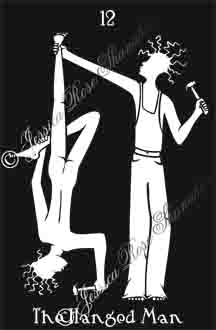
Hanged Man — Tarot of the Absurd

il penduThe hanged man sacrifices himself
for some purpose greater than his own well-being.
A willing victim of his own up-ended perspective,
he pushes aside the popular opinion,
forsakes the temptation of easy gratification
and goes without things commonly seen as “needs”
in attempt to open others’ eyes
to a different world view.


A martyr to some is a traitor to others;
a thief to some is a savior to others.
Bear witness to your true beliefs:
Which side are you on?


*   *   *


I went to the printer’s with my 80 files: 78 cards plus the extra moon plus the silly copyright card. The silly copyright card will be numbered (1 thru 600) and signed, but I’m not going to let you know all the silly words.


I’ve never gone through the process of putting something in print format for the printer before. I needed to make all the files the exact correct dimensions (7cm x 12.5cm) and add bleed and crop marks and make sure the color was correct. Tedious.


I hear the millions (I wish!) asking, “What color?” Oh, if only I could have known before-hand that files need to be in CMYK for print and RGB for screen. For some mysterious reason (feel free to enlighten me in great detail if you know), RGB black does not translate to the same black as CMYK black. Now that I’ve re-learned my lesson the hard way, I recall being told something to that effect a dozen years ago.


Anyhow, all my files were printing some horrible muddied black. I am a person of muddy grays in theory, but I wish the pigment on these cards to appear BLACK BLACK BLACK BLACK BLACK.


The upshot is, I should get to see a proof sometime next week. Yahoo! After I measure how thick the stack of cards is, I will design a box. The box will not be a regular tuck box, because my printer does not have a die to cut them out and I do not wish to cut out 600 boxes by hand (why not? who knows!) so I am making my task even more difficult by having a partly printed, partly handmade box. Thus, no two boxes will be exactly alike.


If anyone is interested in a copy, do feel free to let me know (see the contact info) and I will keep track of you in a very organized manner and let you know when it is ready.


You notice I have not yet mentioned price. This does not mean they will be free. It means I detest setting prices. Ultimately, it will be the low-average price for a LE self-published deck, which is $41 including shipping in the US. Assuming the box is not too much work…


*   *   *


Happy Summer Solstice!

Saturday, June 2nd, 2012

Six of Cups — Tarot of the Absurd

6 of cups meaningArtist: Jessica Shanahan


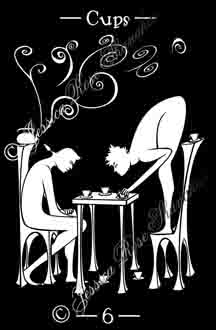
Like unripe fruit, memories sweeten with age. Like fine wine, they leave a complex mingling of flavors on the tongue. The Six of Cups is a card of sweet remembrance of things gone by. It is possible to drink from the cup memory to the point of intoxication and delusion.


When we think we remember something correctly, we must remind ourselves that the contents of the mind are fluid. Beginning at the moment of occurrence, memory of events changes over time. Each one of us— each body— views an event through the filter of our past experiences. Unfortunately, there is no unbiased bank of memory for us to draw from. There is no unbodied observer, completely devoid of experience, with whom we can consult about what really did happen. Each of us sees an event from a slightly different angle, from a slightly different body, from a slightly different mindset. Our memories are skewed by emotion and circumstance. Visions of the past are as plentiful and as varied as visions of the future.


The people on the Six of Cups card descry knowledge of the past by reading tea leaves. Photo albums, journals, scrap-books, stones and driftwood, animal bones, stars and layers of soil, tree rings and faerie rings, a scattering of ashes, the shapes of clouds, a crystal ball, history books, faerie tales, or Tarot cards could all be used for the same purpose. The past is just as certain as the future. Perhaps this card could be seen as a reminder to remain present.

Sunday, May 20th, 2012

The Hermit — Tarocchi dei Celti “Jacovitti”

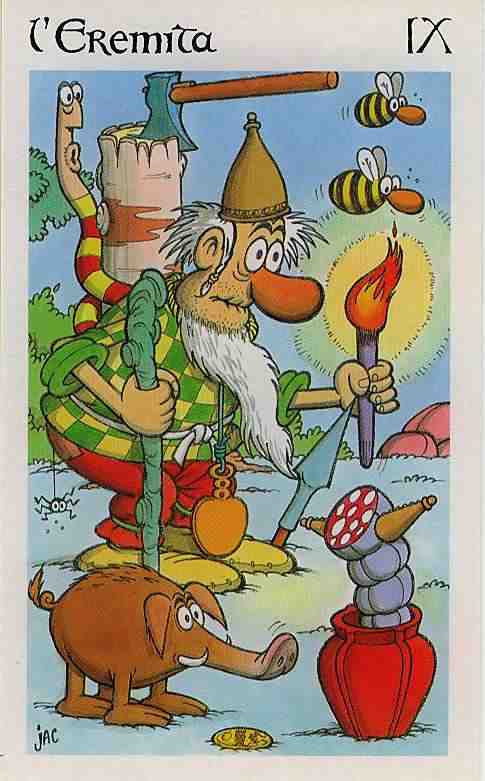
The Hermit turns away from a consumerist, materialistic society to seek answers that arise in quiet solitude. He teaches us to honor timeless inner wisdom. The Hermit understands the myriad of paths that people choose and  helps us with compassionate detachment.


I draw one last card from this deck before I send it away to its new home. The Hermit. Why do I let this deck go so easily? Perhaps because I do not realize its value. Perhaps because I realize value is not intrinsic to an object, but rather given to it by others. Perhaps because it makes me uncomfortable. Perhaps because I know it will be adored in its new home. Most likely I let it go because I am afraid of becoming like my mother in her vast house full of curiosities and wonders. For example, there is a room built specially to house reels and skeins of yarn whose twisted fibers will never touch one of the dozens of knitting machines that lounge about the house, each one purchased in state of disrepair and fixed to perfect working order. They are for sale, if only some one would ask.


Last weekend I asked to borrow my mother’s button collection. I haven’t looked through it in years. I remember three large tins of buttons. They arrived with my sister last weekend, eleven tins of fasteners, each tin averaging 5”x8”x8” in size. One tin contains old coat buttons, hundreds of buttons in muted hues of grays and browns. Another contains white buttons, no mother-of-pearl. Another contains mother-of-pearl buttons only. Another contains antique cards of buttons once sold at 27¢ each. There are buttons to be covered, wooden buttons, woven leather buttons, sequined buttons, glass buttons, silver buttons, and more. Any button, any button. Thousands of buttons— myriads.


I am in the process of having my tarot deck printed. It is a long process because I am learning about papers and bleed and color and layout and nursing all at the same time. The local printer does not have a tuck box die, so I am going to design a card sleeve and then make a box decorated with ribbon and an antique button— hence the buttons— if I ever have two hands free.


There is always an idea. There is always material to carry out the project. There is often not enough time. Even less often is there enough will. The house is full of possibilities. A room of yarn. A room of fabrics. Dozens of sewing and knitting machines, fixed to perfect working order. Paints. Papers. Inks. Rooms full of books. Where is my mother amongst this? It is springtime. She is in the garden, weeding, building fences, moving rocks, planting seeds. Everything in the house can burn, as far as she is concerned. These curious items are nothing. The earth is everything.


The Hermit turns away from a consumerist, materialistic society to seek answers that arise in quiet solitude. He teaches us to honor timeless inner wisdom. The Hermit understands the myriad of paths that people choose and  helps us with compassionate detachment.

Friday, May 11th, 2012

The Two Moons of the Tarot of the Absurd

Jes Shanahan

Artist: Jessica Rose Shanahan


Strange things happen by the light of the Moon.


The Moon shines light on the inner demons of the unconscious—
giving life to the shadow self’s distorted vision—
a moon-shadow landscape of illusion
where dream and reality swirl— undifferentiated—
where the self wanders bewildered and aimless—
anxious and mad— into the arms of deception.


When illustrating the cards in this deck, I incorporated the meaning of the card with a few traditional symbols together with a few symbols of my own into an illustration that attempts to embody the concept of the card intuitively. The conveyed meaning is based largely on posture and human expression rather than on the basis of occult symbols. What allowed me to do this relatively freely was largely my ignorance of the sacredness of symbols in the occult tarot. However, artists invariably have personal symbols that come through in work. Thus the cards— like any work of art— are not devoid of symbols. The symbols are merely different. My goal was to offer a new way of looking at looking at an old idea.


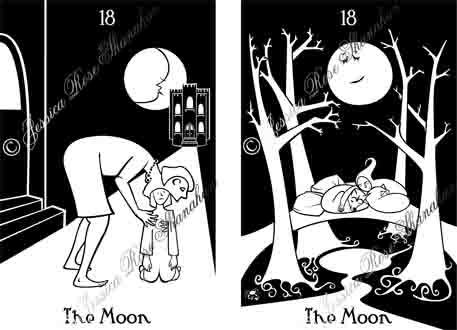
When illustrating the Moon I thought, What is the most deceptive thing? My conclusion was that the most deceptive thing is a creator who brings something into this world and endows it with the faith that it will be loved and cared for and protected fully— then from within the realm of confidence of its creation, the creator becomes destroyer. I illustrated this as a mad mother consuming her own child: the ultimate deception. It is a disturbing image.


This action can be seen overtly in cases of child abuse. However, it also occurs small-scale in every-day relationships. We let people down. Despite our best efforts, we are imperfect mothers, friends and lovers. We deceive and destroy even our own selves. This inevitability begs the question, Who is more greatly deceived in this relationship: the creator or the destroyed?


Upon becoming a mother myself, I find this image more and more disturbing and have found it necessary to deceive myself anew. Thus, I drew a second Moon. The second Moon contains not only the illusion that my creation will have the ability to wander into the wilds unarmed and sleep with the wolves, unharmed, but that I myself will be the perfect mother, able to produce such a miracle. This comforting illusion occurs when we refuse to take off the veil of deception and witness reality.


Unfortunately, although this is the more comforting image, the refusal to see reality ultimately does more harm than good. Facing the truth of one’s destructiveness allows us to better our actions. Choosing some comforting illusion allows us to be lead blindly by our own inner demons into the deception of dreams.


Which Moon you choose is up to you. I leave them both in the deck.

Friday, May 4th, 2012

Verso — Tarot of the Absurd

I drew a picture for the back of the card.

I have recently come to the realization

that many things in life have the ability to wait

but a newborn is not one of them.

I do hope to get my deck printed relatively soon.

Please check up on me now & again!

Thursday, April 19th, 2012

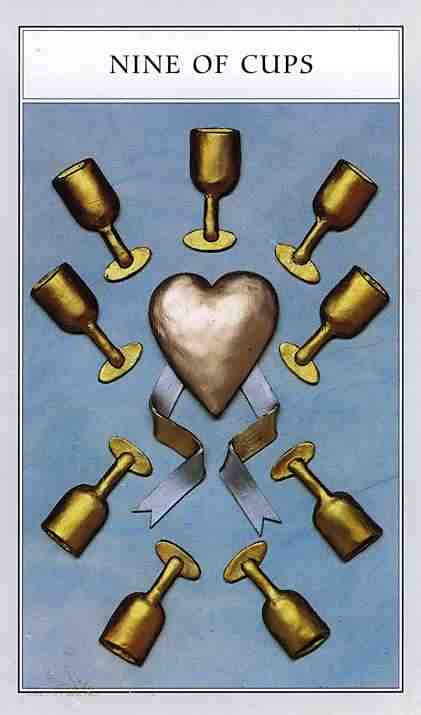
Nine of Cups — Renaissance Tarot

Artist: Helen Jones

Author: Jane Lyle


A delightful person whom I do not know suggested that when I don’t know what to write, I look at others’ blogs for inspiration. So I read her blog today and paraphrase a sentence and steal a few words. Such are the wiles of the writer.


In spite of my “best efforts,” [none] I’m not able to write a blog nearly as often as I like [every day], given that I have to simultaneously nurse a baby and bounce her up and down [okay not simultaneously] when I’m not nursing her and attempt to nap when she’s attempting to nap and— wait— I just stay home all day. Sigh. Actually, I have very little to do. I stare at my baby. I tell people who are visiting me [bless them!] to do things for me. Mow the lawn! Cook me dinner! Wash the dishes!


I draw the Nine of Cups. Enjoy yourself! [It will only get more difficult.]


Sometimes I sit here and stare at my baby and think, “this is exactly what I’ve always wanted.” The thing is, I never thought about wanting this, exactly. It’s contentment and satisfaction and happiness that I’ve always wanted, tho I haven’t always known it. These things come in many forms. In my experience, goal-oriented happiness-seeking does not lead to the same level of contentment as acceptance-of-life happiness-seeking.


A friend I met while planting trees in Alaska has a Chinese (?) tattoo on her shoulder. When I was twenty-two, I asked what it meant. She said— “It means, enjoy life.” Then, with habitual honesty, she edited herself— “Actually, it means enjoy yourself, but I tell people it means enjoy life because I don’t want them to take it the wrong way.”


I thought, “What is the difference between enjoy life and enjoy yourself?” I prefer enjoy yourself. It is somehow both more immediate and more permanent.


Ten years later, working in Hawaii, I met a native man who’d grown up on Ni’ihau. He had the most pleasant temperament, tho he said when he was younger, he was quick to anger. He loved to tell tales and I loved to listen. Whenever it was time for me to go— for it was never time for him to go— he blessed me with the words, “Enjoy yourself.” I thought of the friend I’d met in Alaska when I was younger. I thought how wise these people are, these people who enjoy themselves.


Enjoy yourself!

Monday, April 16th, 2012

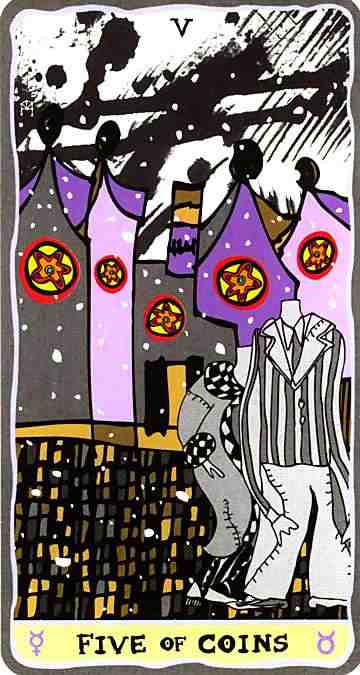
Five of Coins — Sakki-Sakki Tarot

Monicka Clio SakkiArtist: Monicka Clio Sakki

Author: Monicka Clio Sakki & Carol Anne Buckley


Like all fives, the Five of Coins indicates a situation of conflict. The difficulty here is with money, wealth, or possessions. Times are hard. Life sometimes seems meaningless. What is the purpose of such material things as we surround ourselves with? If we open our minds and accept life without the comforts we are used to, what new things do we find? All things material are impermanent.


With patience and courage, the feeling of impoverishment can be overcome. The tools to do the dirty work are with us all the time. It is easy to look in the accustomed places for comfort and a sense of belonging; it is difficult to see a whole new world of riches that lies just beneath our feet.


•   •   •


I once lived in Hawaii. I worked with an arborist in an immense botanical garden, where I climbed trees big enough to hold tree-mansions. In my spare time, I swam in the ocean, out in the open ocean, swam from beach to beach out in the ocean, all alone. I brought nothing with me. I wore goggles and a swimsuit. I swam for hours on end. I swam with turtles, dolphins, humpback whales, and a myriad of fishes, out there, all alone. I came to land like a mermaid, uneasy on my legs. I was in love with the ocean. I was madly in love with the ocean. It was almost enough to sustain me— but I was missing community. I had no family. I belonged in the ocean, all alone, but I did not belong on land.


When my boss became tyrannical and abusive, I had no where to turn for help. His actions took away the beauty I had found in life. I became sick. I had no energy. Hanks of hair fell out of my head; much of my remaining hair turned white. Eventually, I realized the most important thing is family. Because I had not made a new family of people to surround myself with, I decided to return to the northeast US, where I grew up. I have family here. I know the seasons. This is my wealth. This is my community. These are the riches that have been beneath my feet all my life. When something is lost and something new appears, quite often, it has been there all along.

Friday, April 13th, 2012

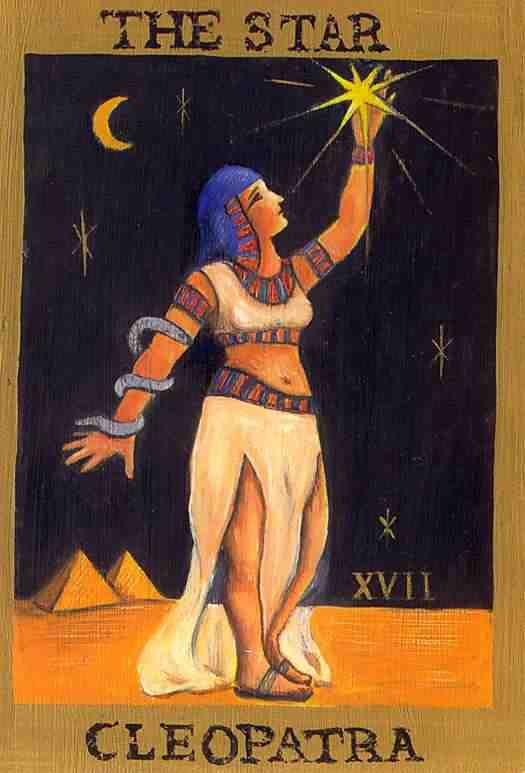
The Star — The Shakespeare Oracle

Artist: Cynthia von Buhler
Author: A. Bronwyn Llewellyn


The first time I passed through Oaxaca, Mexico, I had one of the most amazing dreams of my life.


I dreamed I was a woman living in a small village in the mountains. I was newly in love and newly married when my new husband went off to war. He said to me before he left, “While I’m gone, make me a weaving.” So I made weavings. Every day I made weavings, weaving to no end until one day I said, “I can’t do this anymore. I have to stop. I have to do something else.”


I wanted to join the army. I bypassed all the armed forces where women are accepted. I walked until I came to a cement house where it was cold. I went inside. The house overlooked a canyon— a canyon familiar to my dreams, into which I often dove on wings of faith in search of freedom. The men inside wore black: black clothing, black hoods over their faces. This sector of the army was kept secret from women. No woman knew of it; none had ever been here.


I picked up a gun. “I wanted to fight,” I said.


The men looked at me askance. “You are a woman,” said one of them.


I saw into their hearts and knew then it was not a sexist remark. The men were aware that I could fight as well as they could, but they cared too much about me. Each one of them loved me and would not let me do this to myself. This squadron meant death.


In came the man in charge. He said I could not join. I was furious. One man after another of higher rank came in until at last in came the Zen Master. I paced in small circles as we talked.


I said, “I thought I knew this. I used to know what I was doing. I used to know detachment. I thought I knew what Zen was.”


He said, “We are all just learning.” He said, “Show me your weavings.”


I brought them out. He lifted up each of the weavings one by one and held each one in admiration. Each weaving depicted a different woman, sitting, weaving. There were piles of them, dozens and dozens of weavings, large, and in bright colors. The man nodded at each one. He knew the names and villages of all the women. He spoke highly of their weaving and spoke highly of mine.


At the bottom of the pile was a small weaving of a young child holding an empty spoon before her with two hands, as if in offering. The Zen Master could not place this image; he had never seen such a child. He asked, “What is this?”


I turned my head and looked at the floor. My eyes blurred with tears. I said, “Oh. That one doesn’t belong.”


He said, “Then get rid of it.”


“I can’t,” I said, and began to sob helplessly. “It’s my hope.”


“Well then,” the Zen Master said to me, “get rid of all the others.”


And I woke, sobbing.


*   *   *


The woman in the next bunk in the hostel noticed when I woke. She said she heard me crying but didn’t want to wake me in the middle of a dream. She sat at the head of my bed and listened as I told her my dream, crying. She said she never had dreams like that. I thanked her for listening. I am so thankful for her, so thankful for this unknown woman from Israel, for without her waiting for me to awaken and without her listening, I may never have remembered the most beautiful dream of my life: the dream of what hope is.


Hope is The Star. Get rid of all else.