


My mom completed her first plumbing job 64 years ago, at age five. She fixed a sink.
My grandfather was so impressed, he wrote her a song. Something about
“When I plumber earns five dollars an hour / I guess that ain’t so bad.”
Which it wasn’t: minimum wage was 40¢ an hour and the average annual salary was $3,600 per year.
In a full-on attempt to out-do her, Iris tackled her first plumbing job at a year and a half.
Despite the fact (or perhaps because of the fact) that there were numerous people involved,
the sink is still not fixed.
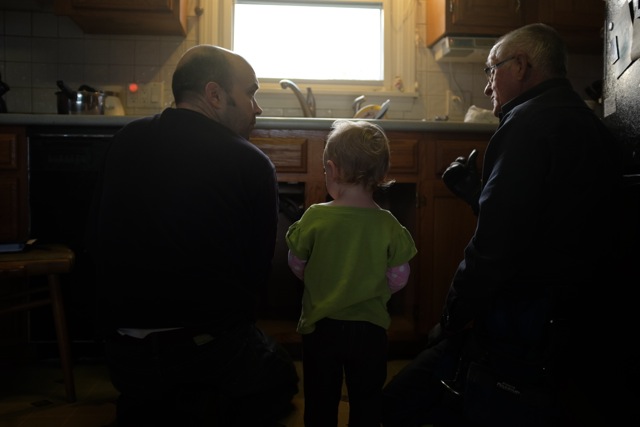
Nobody wrote a plumbing song for Iris.
I got ANOTHER new camera: Fuji x100s. This is my first post.

I think the colors are even more delicious-er.
Grades 5 through 8 had a cross-country race in the field. There were many schools.

On the sidelines, Joshua and Iris came up with their own game.
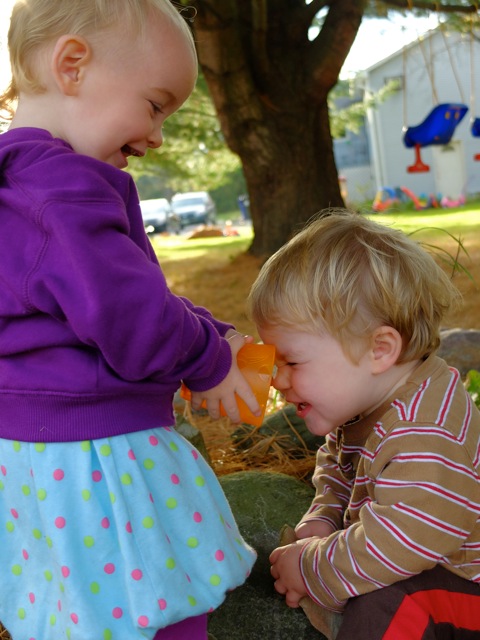
It was called “Put the Cup on Joshua’s Face,” and it was hilarious!

Iris’ best friend.

I decided to stop by Kathy’s house. She was just getting home when I biked up.
Scott had been working on her truck, so she’d borrowed his car. But oops, she scratched it!
She felt horrible, giving him something else to fix when he was doing so much work.
But he forgave her. See? All those electric wires criss-crossing everywhere and—
Zoom! Zoom! Electric wires so hot they shoot out of Scott & Kathy’s heads with a kiss!

(Wait. Or is that a dormant tree?)
Kathy thinks its funny that I like photos of people sitting on front steps.
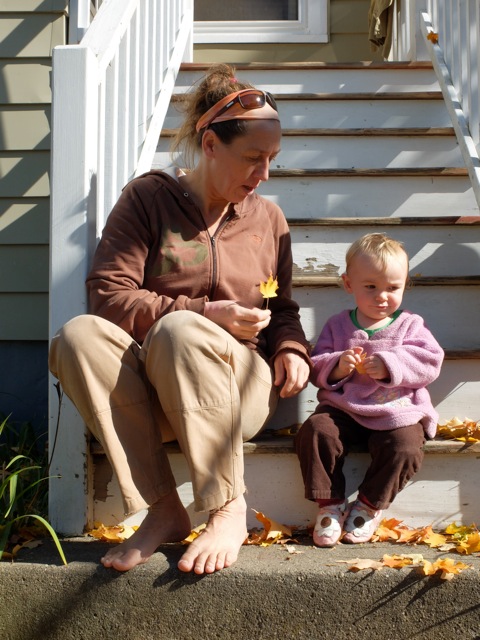
Kathy & Sabien chat over popcorn.

Between the Inn and the Carriage House at Shelburne Farms.


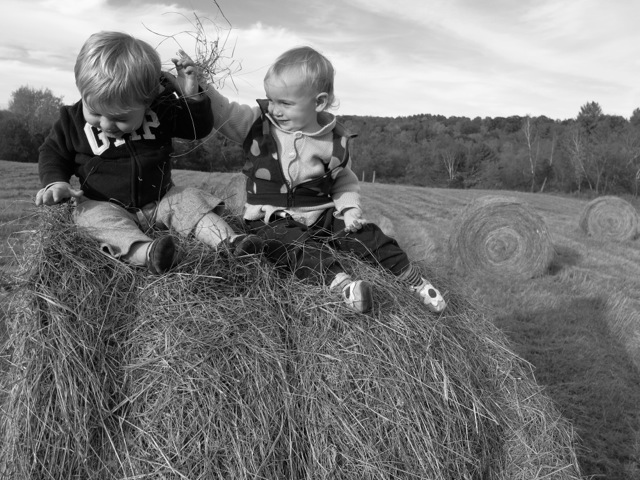
Joshua and Iris pose on hay bales

Iris takes pleasure in Joshua’s good nature.
For dinner we had

ox heart stroganoff

with barley

and peas.

And raw milk. Iris loves raw milk from an assortment of mammas.

I mean, mammals.

She ate a good amount,
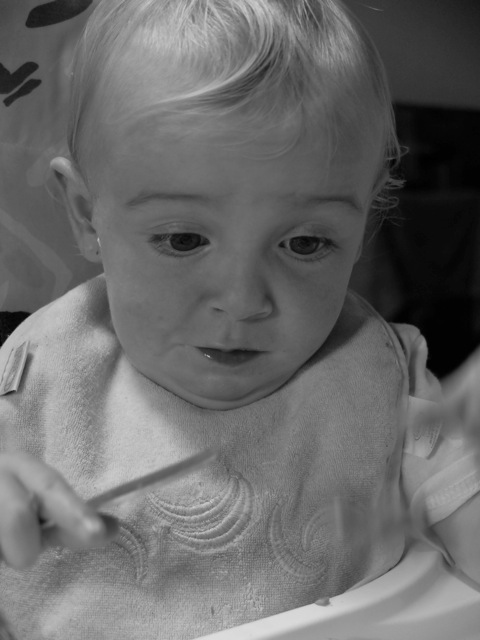
mostly before sitting at the table.
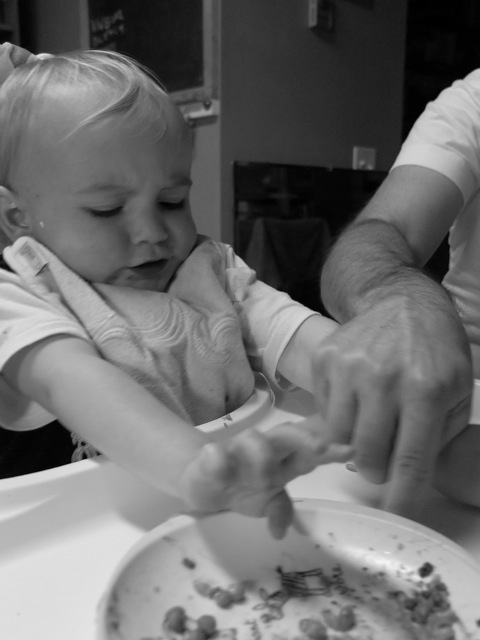
Papa feeds her. We both adore him.

Bizou a Papa!

Mama! Mama!

Two toddlers, both short on sleep, get together on a rainy day to study color theory.
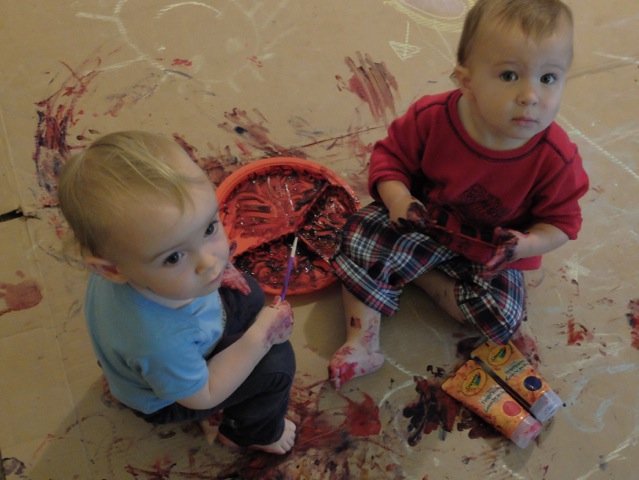
Iris discovers the many shades of brown.
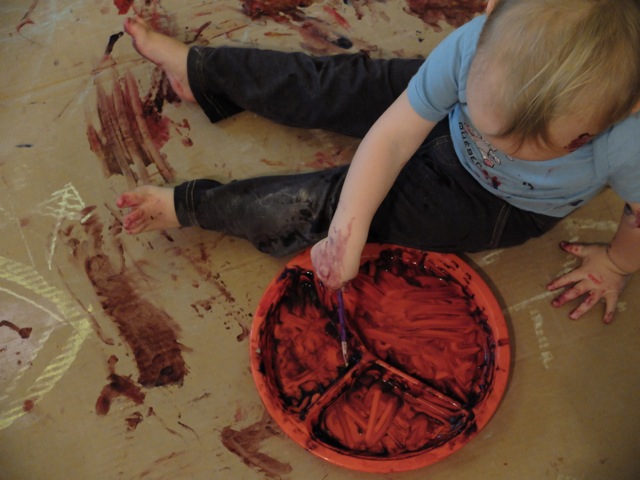
This is your typical shot of a professional painter hard at work on one of his canvases.
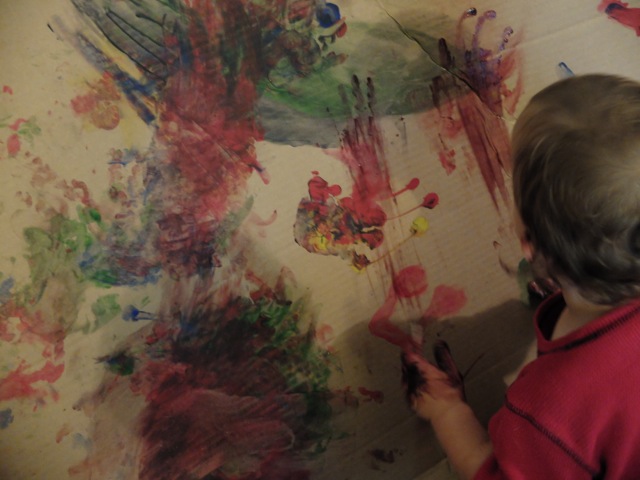
*
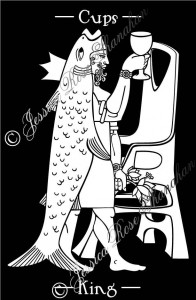
The King of Cups was the final card illustrated for the Tarot of the Absurd. My baby was coming soon. Working all day in front of the computer made my ankles disappear into puffiness. I needed a King, and I needed him fast. I cheated— I, too, stole the image of an ancient god.
At first, humans were rather wretched and lived like all other wild beasts. But within one year, a reasonable beast named Oannes emerged from the Erythian Sea, at the point where it borders Babylonia (i.e.: the Persian Gulf). He had a fish’s body. Above his fish’s head he had a man’s head. Human feet emerged from beneath his fish’s tail. His voice was human. He was never seen to eat.
He passed his days among civilization. He taught the use of letters, sciences and arts of all kinds. He taught men to construct cities, to found temples, and to compile laws. He explained the principles of geometry. He made them learn their plants and showed them how to harvest. In short, he humanized them. No one has ever improved on his instructions. And when the sun set, Oannes retired into the sea, for he was amphibious. After this, there appeared other animals like Oannes.**
Over the years, the confusion of gods multiplies. Who came from whom? Where are the origins? One can trace the threads of mythology’s history like a spider’s web, each strand weaving back upon the others to create a structural whole that makes sense for the present time. Deconstructing mythology— deconstructing the spider’s web— is fascinating from a historical point of view, from a story-teller’s point of view, and from the point of view of those interested in following multitudes back to unity. Mythology is the bizarre sort of lineage where a parent begets a child and the child becomes not just a parent, but the parent of his own self.
Deluge and recovery. Subjugation, assumption, resurrection. In order to better subjugate the conquered people, the gods of the victors assume characteristics of the gods of the vanquished, and the gods of the vanquished rise again. Thus the names and places of gods change through the ages, one god after another taking on similar forms and forces, gods amassed and gods split
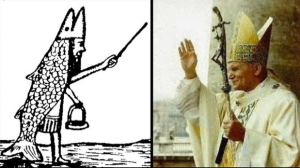
Adapa. Oannes. Dagon. Poseidon. Neptune. Triton. Delphin. Noah. Names of gods come and go, but the robes of priesthood have changed very little. Three or five or seven thousand years later, Catholic popes and bishops still wear the headdress dedicated to an ancient Babylonian water god.
… and after this, there appeared other animals like Oannes…
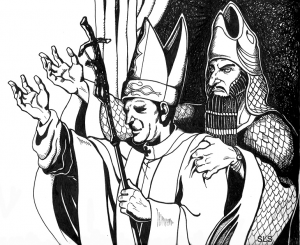
***
* My illustration is very, very closely modeled after a bas-relief carving of a fish-garbed priest on temple of the god Ninurta (Saturn) at Kalhu (biblical Calah), ca. 883-859 BCE Assurnasirpal II. Source: Anthony Green, Gods, Demons and Symbols of Ancient Mesopotamia, An Illustrated Dictionary, p. 83. fig. 65. Published in London by the British Museum, in association with the University of Texas Press, Austin. 1992.
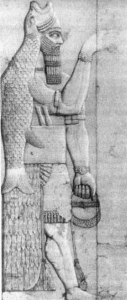
** Story, in italics, adapted from Berossus, a 3rd century BCE Babylonian priest. Oannes is born of the Mesopotamian god Enki, whose origins go back to the 5th century BCE in Sumer; i.e.: as far back as we have writing.
*** Pen&Ink ilustration by Syrena Seale. Image used without permission, but I would like to use it, with permission, in my book. To see the original image and to see more of Syrena Seale’s work, click here or click on her illustration.